Castle Rock
Castle Rock, Maine, is the fictional town at the heart of Stephen King's "The Body," a place that functions as both a physical setting and a powerful social determinant for its characters. It is a town of sharp contrasts, where the lives of its residents are shaped by class, family reputation, and the geography of the surrounding landscape. The town is the home of the four main characters—Gordon Lachance, Chris Chambers, Teddy Duchamp, and Vern Tessio—and its streets, landmarks, and social hierarchies form the crucible in which their childhood adventure unfolds.
Geography and Landmarks
The town is defined by a series of key locations that serve as the backdrop for the boys' experiences. The treehouse, built in a big elm overhanging a vacant lot, is a social club where the boys play cards, smoke cigarettes, and look at girly books, a private space scavenged from the town's refuse. The Castle Rock Dump is one of the strongest memories of the town for the narrator, a surrealist landscape of discarded American things, guarded by the feared dog Chopper and his keeper, Milo Pressman. The GS&WM railroad tracks run through the town, leading to the trestle over the Castle River, a perilous crossing that tests the boys' courage. The Castle River itself, broad and shallow at the end of a drought, is a central feature, its smell like a laundry hamper full of mildewy towels. Other significant locations include the Florida Market, where Gordon confronts the owner George Dusset, and the Blue Point Diner, behind which Chris reveals his father's .45 pistol.
Social and Economic Stratification
Castle Rock is a town with a rigid class structure, where family reputation determines a person's place. The boys come from the "shirttail" variety of families, with none from the upper crust. Gordon's father is retired, Vern's works in the mill, Teddy's mother takes in boarders, and Chris's father is a drunk who gets welfare. The town's judgment is harsh and unforgiving, particularly for the Chambers family, who are considered "no-account." This stigma follows Chris, who is automatically blamed for stealing milk-money because of his family name, a prejudice that shapes his entire outlook on life. The town's adults, like George Dusset and Milo Pressman, embody the petty cruelties and prejudices of small-town life, while others, like the dump-keeper, are seen as half-bright working joes.
Narrative Significance
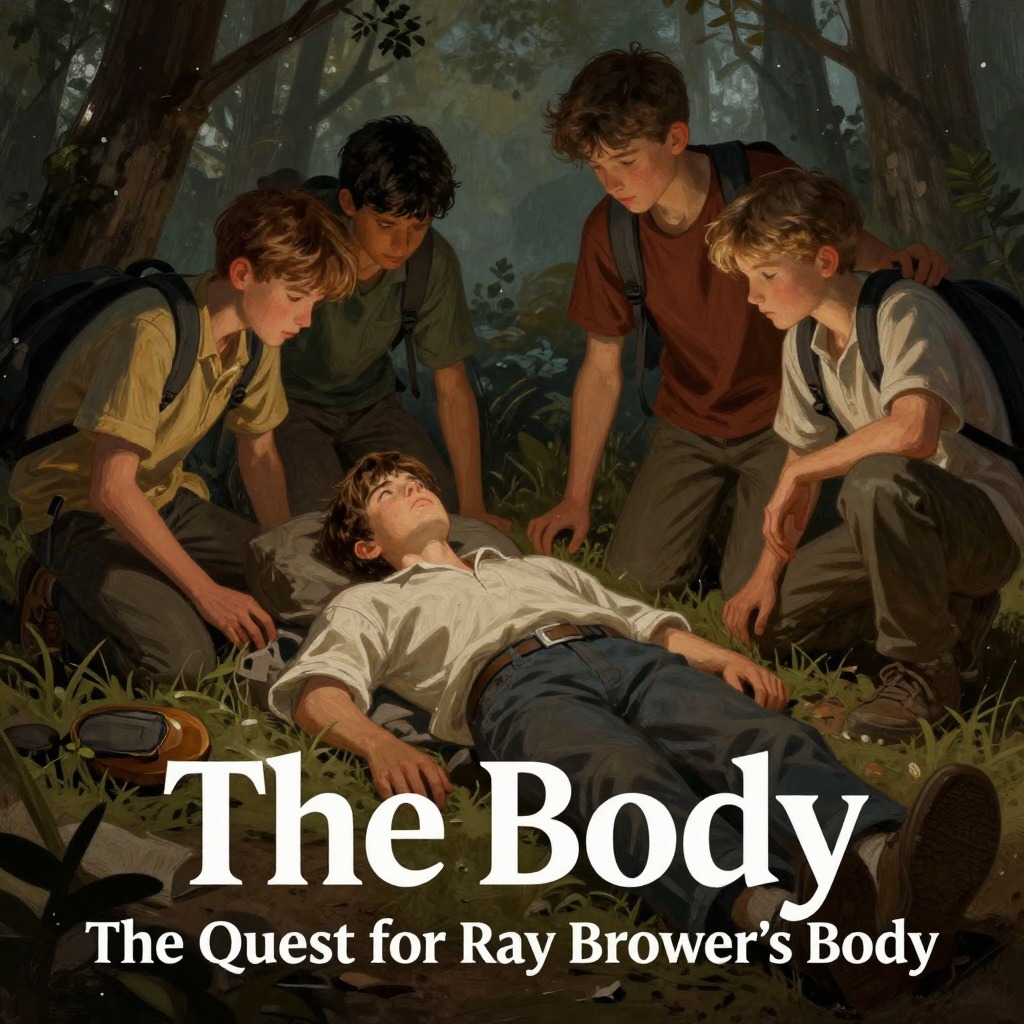
Castle Rock is not merely a backdrop but an active force in the story. It is the place the boys are desperate to escape, a town that seems to offer no future for those born into its lower classes. Chris Chambers articulates this despair, believing he will never get out of Castle Rock, destined to end up in the mill or a shoeshop. The town's geography, from the vacant lot to the railroad tracks, provides the physical corridor for the boys' rite of passage. The journey to find Ray Brower's body is a journey away from the familiar constraints of Castle Rock and into the unknown wilderness of Harlow, a different country altogether. The town's social dynamics, particularly the threat of Ace Merrill and his gang, follow the boys even into the woods, forcing a final confrontation that cements the end of their childhood. The story's conclusion, with Gordon seeing an older, unrecognizable Ace Merrill in a station wagon, underscores how Castle Rock itself remains unchanged, a place where some people drown and others, like Gordon, manage to escape, but only by leaving the town and its memories behind.